
Uncategorized | GleamClean WA - Commercial Cleaning Perth
Corporate kitchen cleaning tips help transform hygiene maintenance into a simpler, more organised and efficient routine.
Unlike a home kitchen, a corporate space can be used by many people throughout the same day, increasing contact with tables, fridges, microwaves, coffee machines, taps and benchtops.
Because of this, following good corporate kitchen cleaning tips is important not only to maintain a neat appearance, but also to reduce residue buildup and provide a more pleasant environment for staff.
To achieve good results, there is no need to push all cleaning tasks to the end of the day. A more efficient strategy is to divide tasks according to the required frequency, combining daily maintenance with periodic deep cleans.
Organise cleaning according to usage frequency
One of the main corporate kitchen cleaning tips is to observe how each area is used. Not all surfaces require the exact same cleaning frequency.
High-touch points need greater attention
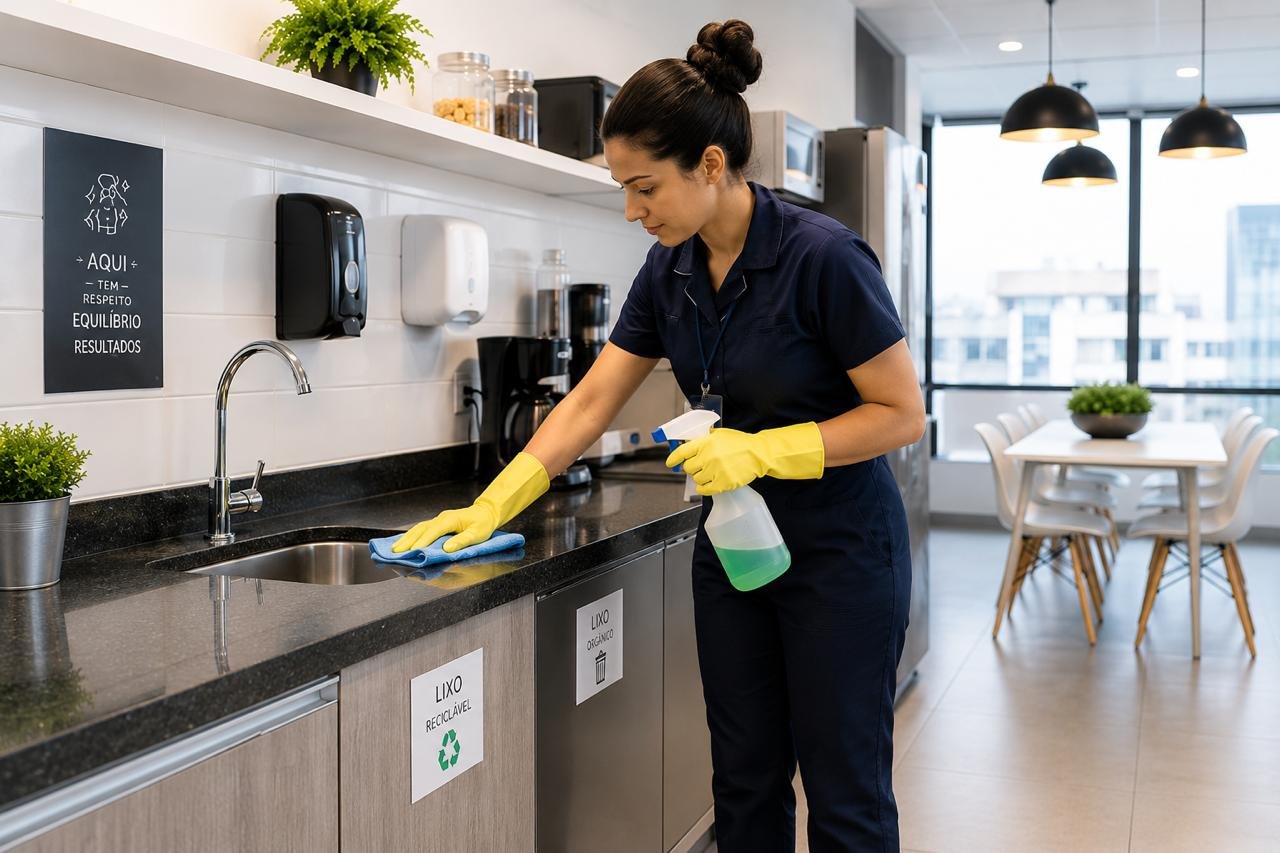
Tables, benchtops, taps, fridge handles and microwave buttons are examples of surfaces touched multiple times throughout the workday. Therefore, they may require frequent cleaning, especially in companies with a large workforce.
On the other hand, the interior of cupboards or certain appliances can be included in a weekly or periodic schedule, depending on usage levels.
This organisation prevents both task overload and the omission of important areas.
Choose the product according to its intended purpose
Another corporate kitchen cleaning tip that deserves attention is avoiding the indiscriminate use of a single product across the whole kitchen.
Cleaning and disinfection have different objectives
The TGA distinguishes general cleaners from products intended for disinfection, with different regulatory requirements applying depending on the product’s intended use and antimicrobial claims.
In practice, detergents and general cleaners can be used to remove residues and grease, whereas products with disinfectant action serve a different purpose. Understanding this difference allows for more suitable processes in each situation.
It is also important to check whether the chosen product is compatible with the surface on which it will be applied.
Read the instructions before using products
Among corporate kitchen cleaning tips, this one may seem obvious, but it makes a huge difference in the results.
Correct dilution prevents waste
Concentrated products must be prepared according to the ratios specified by the manufacturer.
TGA guidance for regulated disinfectants requires the directions for use to include appropriate dilution instructions where dilution is necessary.
Adding more product than recommended does not necessarily yield a better clean. Besides increasing costs, excess product can leave residues or damage certain surfaces.
Likewise, diluting more than recommended can reduce expected efficiency.
Avoid mixing different products
Homemade chemical mixes should not be part of corporate kitchen cleaning tips.
Combinations can cause dangerous chemical reactions
The TGA advises that disinfectants should be used in accordance with the manufacturer’s instructions, including any directions regarding dilution, application and safe handling.
The ideal approach is to use each product individually and solely for the purpose indicated on the label.
Furthermore, personnel responsible for cleaning should receive guidance on product handling and use the personal protective equipment recommended by the manufacturer.
Separate the materials used for hygiene tasks
Cloths, sponges, brushes, mops and buckets also need to be organised.
Separation helps prevent cross-contamination
Using a cloth on the floor and later using it on a benchtop is a practice that must be avoided.
A simple solution is to assign specific gear to each area, including implementing colour-coded identification.
As a good practice in food service establishments, cleaning equipment used for floors, walls and other facility areas should be kept separate from equipment used to clean food-contact surfaces, helping to minimise the risk of cross-contamination.
This separation makes the routine more organised and helps prevent cleaning itself from spreading dirt around the environment.
Pay special attention to the shared fridge
When thinking about corporate kitchen cleaning tips, the fridge deserves dedicated planning.
Establish a routine for forgotten food
In a shared fridge, it is common to find open packages, unlabelled food and items forgotten for days. In addition to taking up space, these items can cause leaks and bad odours.
The company can set specific days to inspect and clear out expired or abandoned food, notifying staff in advance.
Shelves, drawers, internal walls, rubber door seals and handles must also be cleaned periodically.
Include microwaves and coffee machines in the schedule
Some appliances are used dozens of times a day and end up accumulating residues rapidly.
Quick touch-ups prevent tough dirt
In the microwave, splashes should be removed before they dry and stick to the inner walls. In coffee machines, trays, reservoirs and other removable parts need to receive the care indicated by the manufacturer.
One of the best corporate kitchen cleaning tips is not to wait for appliances to show stains or odours before adding them to the routine.
Take proper care of benchtops
Benchtops are used to rest packaging, utensils, food and personal belongings. Therefore, they require frequent attention.
Remove loose dirt before applying other procedures
Food scraps and spilled liquids should be wiped away first. Afterward, the surface can undergo the hygiene procedure appropriate for its material.
In environments operating as food services, RDC 216 requires facilities, equipment, furniture and utensils to be maintained in adequate hygienic-sanitary conditions, with cleaning frequencies that minimise the risk of food contamination.
Store cleaning chemicals correctly
Corporate kitchen cleaning tips must also consider what happens after cleaning is complete.
Create a dedicated space for cleaning chemicals
Dishwashing liquids, degreasers, disinfectants and other products should not be mixed with food or kitchen utensils.
RDC 216 establishes that cleaning chemicals used in food services must be clearly identified and stored in a designated space reserved for that purpose.
Keeping a dedicated cupboard also facilitates inventory control and prevents products from being used incorrectly.
Create a simple schedule that is easy to follow
An efficient routine needs to be easily understood by everyone involved.
Divide tasks into shifts or time blocks
High-use surfaces can receive attention multiple times throughout the workday. Floors, sinks and bins should be part of the daily routine, while cupboards, fridges and other structures can follow a specific periodic schedule.
RDC 216 also provides for standardized hygiene procedures in food services, including sequential instructions, frequency and assigned personnel.
Even in a simpler corporate kitchen, applying this principle as a guideline helps organize tasks much better.
How to keep the corporate kitchen clean for longer
Corporate kitchen cleaning tips involve much more than just choosing good products.
It is necessary to define frequencies, separate materials, care for shared appliances, use cleaning chemicals correctly and train those using the space.
By incorporating these corporate kitchen cleaning tips into the routine, the company can prevent dirt buildup rather than reacting only when problems appear.
With proper planning and simple procedures, the kitchen remains more organised, functional and pleasant throughout the entire workday.