
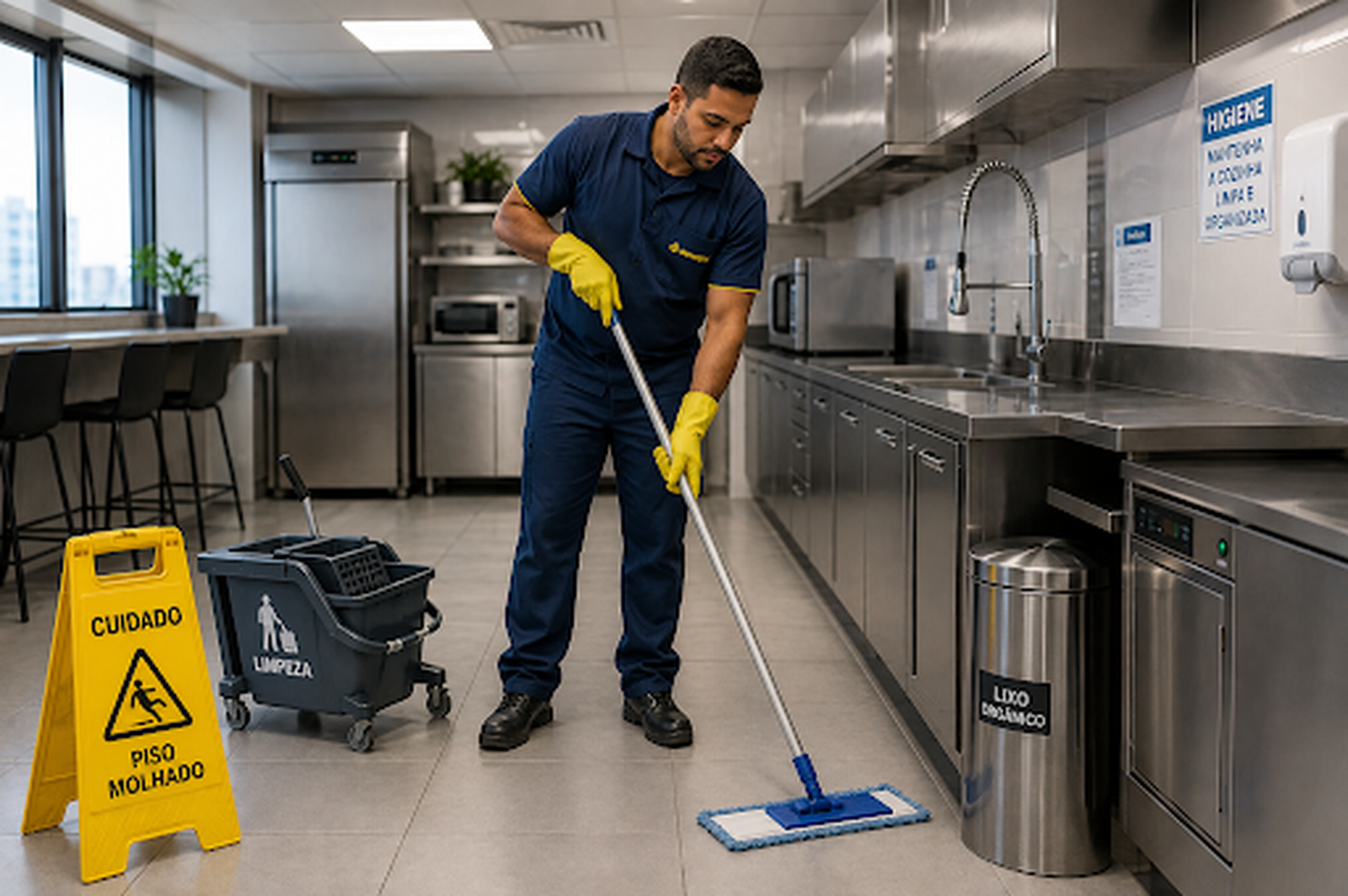
Corporate Kitchen Cleaning Kit: Essential Items for Complete Hygiene
Setting up an appropriate corporate kitchen cleaning kit is a practical way to make cleaning more organised, efficient and safe.
As these spaces are shared by various staff members throughout the workday, food residues, splashes, grease and frequently touched surfaces are common.
Because of this, a good corporate kitchen cleaning kit should bring together products and utensils for different needs, from benchtop cleaning to the care of floors, appliances and high-touch areas.
Rather than buying random products, the goal is to select items with specific functions that are compatible with the materials present in the environment.
TGA (Therapeutic Goods Administration) specifies that disinfectants under its regulation must be used in accordance with the manufacturer’s instructions, including recommendations regarding dilution, contact time, and directions for use.
How to Set Up a Corporate Kitchen Cleaning Kit?
The first step is to assess the kitchen’s structure and routine. A small kitchenette used mainly for coffee and ready-to-eat meals will have different needs compared to a corporate kitchen where food is prepared frequently.
Consider the flow of people
The higher the number of staff using the space, the higher the required cleaning frequency tends to be. Benchtops, tables, taps, handles and shared equipment need special attention.
Therefore, the corporate kitchen cleaning kit should facilitate both quick touch-ups during work hours and more thorough cleaning at scheduled times.
Dishwashing liquid to remove everyday dirt
Dishwashing liquid is one of the basic items for assembling a corporate kitchen cleaning kit.
A versatile product for the daily routine
Dishwashing liquids help remove residues and grease from compatible utensils and surfaces.
They can be used for different tasks depending on their indicated use, making them especially important for daily maintenance.
In Australia, the TGA distinguishes general cleaners and detergents from disinfectants. General cleaners and detergents without disinfectant claims are generally not regulated by the TGA, while products intended to kill microorganisms on inanimate surfaces may be regulated as disinfectants.
It is important to check the manufacturer’s guidelines before use, particularly to confirm which materials the product can be applied to.
Degreaser for tougher areas
Another useful product for the corporate kitchen cleaning kit is degreaser.
Grease can build up even without heavy cooking
Microwaves, cooktops, benchtops and areas near food preparation can accumulate greasy residues. When not removed quickly, these residues tend to stick to surfaces, making cleaning more laborious.
A product suitable for this type of dirt makes maintenance easier, provided it is compatible with the surface being cleaned.
Disinfectant to complement hygiene
Depending on the kitchen’s characteristics and requirements, products with disinfectant properties can also be included in the corporate kitchen cleaning kit.
Correct use is essential
Disinfection should not be confused with simple dirt removal. Therefore, each step must be performed using products suited to its specific purpose.
It is also necessary to respect the concentration, application method and contact time specified by the manufacturer. RDC 216 establishes these guidelines for sanitising products used in food services.
Products with antimicrobial action also come with specific safety instructions, including warnings against mixing them with other products unless explicitly specified by the manufacturer.
Microfibre cloths help clean surfaces
A corporate kitchen cleaning kit is not made of chemical products alone. The utensils used also directly affect the quality of the work.
Separate cloths according to their purpose
Microfibre cloths are useful for benchtops, tables and various surfaces because they offer excellent removal and absorption capabilities.
A good strategy is to assign different colours to each area. A cloth used in certain sections should not be cross-used across the entire kitchen.
As a guideline, RDC 216 stipulates that utensils used to clean facilities must be kept separate from those used to clean parts of equipment and utensils that come into contact with food.
Sponges and brushes complete the kit
Sponges and brushes are important for reaching different types of surfaces and dirt.
Choose the material according to the surface
A scouring sponge might be effective in a given situation, but it can also scratch more delicate finishes.
Therefore, it is important to follow recommendations for surfaces such as stainless steel, glass or specific coatings.
Smaller brushes can be reserved for corners and hard-to-reach areas, while other models can be used on sinks or compatible surfaces.
Mops, squeegees and floor cleaning materials
Floors must also be considered when assembling the corporate kitchen cleaning kit.
Have dedicated equipment for this area
Mops, squeegees, buckets and cleaners compatible with the flooring type facilitate the removal of residues and liquids.
These utensils must be kept separate from those used on benchtops, tables and equipment.
In addition to hygiene, keeping the floor dry and clear of spills helps reduce hazards that could cause slips as staff move around.
Gloves and other PPE are also important
Depending on the products used, Personal Protective Equipment must be part of the corporate kitchen cleaning kit.
Always consult safety guidelines
Gloves are frequently required when handling cleaning chemicals, while certain products may demand additional protective gear.
The selection should follow the information provided on the label and the applicable safety guidelines for the product.
The TGA (Therapeutic Goods Administration) requires disinfectant labels to provide essential information for their appropriate use, including clear directions for use and relevant safety information..
Have a dedicated space to store the kit
Once the corporate kitchen cleaning kit is assembled, you need to designate where all items will be stored.
Cleaning products must be kept away from food
Leaving detergents or disinfectants near food and utensils is bad practice.
In food services, RDC 216 requires cleaning chemicals to be clearly identified and stored in a designated space for that purpose.
A dedicated cupboard also makes inventory control easier and allows you to see quickly when a particular product needs restocking.
Avoid mixing products and improvising
Having a complete kit reduces the need to improvise solutions during daily operations, which is not recommended practice.
More products do not mean higher efficiency
Mixing cleaning chemicals can cause adverse reactions and does not automatically make cleaning more effective.
TGA guidance emphasises that disinfectants should be used according to the manufacturer’s instructions, including following the recommended dilution ratios and avoiding mixing products unless specifically directed.
Thus, it is better to rely on specific products and use them correctly than to combine different substances to boost their effects.
How to make the most of the cleaning kit day to day
A good corporate kitchen cleaning kit should be planned according to the characteristics of the space and the staff routine.
Dishwashing liquids, degreasers, disinfectants where necessary, cloths, sponges, brushes, mops, squeegees and protective equipment form a system capable of meeting core hygiene needs.
Beyond selecting items, organizing their use is essential. Colour-coding materials by area, following manufacturer guidelines and storing products correctly makes the corporate kitchen cleaning kit more efficient and safe.
This way, the business can maintain a standardized routine and a cleaner, more organized and pleasant environment throughout the workday.