
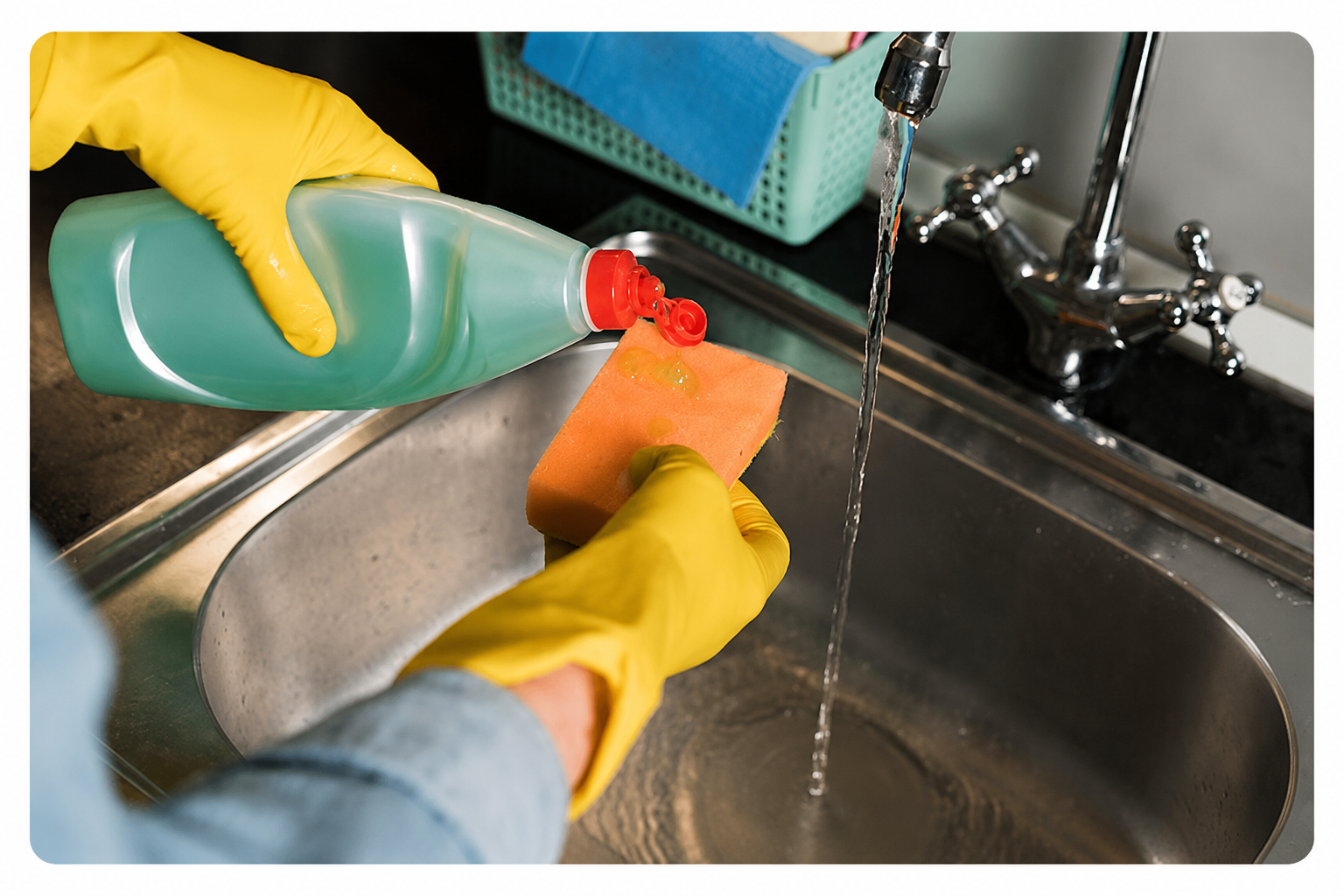
Industrial kitchen cleaning errors: the main problems that compromise food safety
Industrial kitchen cleaning errors can endanger food safety, compromise equipment conservation, and even cause problems during sanitary inspections.
In environments where food is constantly handled, sanitisation needs to follow strict procedures to avoid contamination and guarantee the quality of processes.
Therefore, knowing the main industrial kitchen cleaning errors is essential to maintain a safe, organised environment that complies with good practice regulations.
Often, cleaning is carried out daily, but small incorrect habits end up reducing its efficiency.
From the inappropriate use of products to flaws in team organisation, these errors can favour the proliferation of bacteria, fungi, and other microorganisms.
In this article, you will learn about the main industrial kitchen cleaning errors and discover how to avoid them.
Why avoiding industrial kitchen cleaning errors is so important
The industrial kitchen is an environment that combines heat, moisture, and organic residues—factors that favour the growth of microorganisms.
When cleaning is not carried out correctly, the risk of cross-contamination, food waste, and problems related to food safety increases.
Additionally, industrial kitchen cleaning errors can reduce the lifespan of equipment, cause grease build-up, and make it harder to comply with the requirements established by sanitary surveillance bodies.
Correcting these flaws is a way to protect both consumers and the professionals who work on-site.
Using inadequate products for each surface
Among the main industrial kitchen cleaning errors, the use of inadequate products is one of the most frequent.
Incorrect products can damage equipment
Stainless steel, aluminium equipment, and surfaces intended for food preparation require specific products.
Highly abrasive products can cause corrosion, stains, and loss of finish, reducing the durability of the equipment.
Furthermore, some products can leave chemical residues that pose risks when they come into contact with food.
The importance of the correct choice
Each stage of cleaning requires a specific product. Detergents remove grease residues, degreasers act on heavier dirt, and disinfectants eliminate microorganisms. Using each product for its correct function increases the efficiency of the sanitisation.
Skipping the cleaning stage before disinfection
Another main industrial kitchen cleaning error is applying disinfectants directly onto dirty surfaces.
Dirt reduces the disinfectant’s action
Food scraps, grease, and dust form a barrier that prevents direct contact between the disinfectant and microorganisms.
As a consequence, disinfection does not occur efficiently. For this reason, cleaning must always happen before applying the disinfectant.
The correct procedure
First, it is necessary to remove all visible dirt using appropriate detergents or degreasers. Only after this stage should disinfection be carried out.
Not respecting the dilution and action time of products
Industrial kitchen cleaning errors also happen when products are used differently from the manufacturer’s recommendations.
Excess or lack of concentration
There is an idea that using a larger amount of product increases its efficiency. In practice, this can cause waste, leave residues on surfaces, and even damage materials.
In the same way, excessive dilution reduces the cleaning and disinfection capacity.
Contact time is fundamental
Each product needs to remain in contact with the surface for a specific period to work correctly. Removing the product before this time significantly reduces its effectiveness.
Using the same materials in different areas
Another industrial kitchen cleaning error that deserves attention is using the same cloths, sponges, or brushes in distinct areas.
The risk of cross-contamination
When a cloth used on floors is employed to clean counters or equipment, there is a high possibility of transferring microorganisms between different surfaces.
This practice increases the risks of food contamination and compromises the entire sanitisation process.
Organisation of materials
Separating cleaning materials by area of use is a simple measure that contributes to maintaining a much safer environment.
Forgetting equipment and hard-to-reach areas
Many industrial kitchen cleaning errors happen because the team concentrates cleaning only on the most visible surfaces.
Grease accumulated in equipment
Hoods, extractor fans, skirting boards, tracks, upper shelves, and areas behind equipment tend to accumulate grease and dust over time.
When these regions do not receive periodic cleaning, they become ideal places for the development of microorganisms and pests.
The importance of complete cleaning
A schedule that includes deep cleans at regular intervals helps avoid this type of problem and keeps all environments in good condition.
Not training the cleaning team
Among the biggest industrial kitchen cleaning errors is the lack of training for the professionals responsible for sanitisation.
Knowledge makes a difference
Even when using quality products, an untrained team can make errors in product dilution, application, or storage.
Furthermore, incorrect procedures increase material consumption and reduce cleaning efficiency.
Standardisation improves results
Periodic training helps establish standardised procedures, ensuring that all employees execute cleaning in the same way and follow safety regulations.
Leaving cleaning only for the end of the shift
Another industrial kitchen cleaning error is accumulating all sanitisation for the close of activities.
During food preparation, residues accumulate quickly. When cleaning occurs only at the end of the day, grease dries up and dirt becomes harder to remove.
Adopting small cleans throughout the shift facilitates environment maintenance and reduces the time required for complete sanitisation.
Conclusion
Industrial kitchen cleaning errors can compromise food safety, increase operational costs, and reduce the lifespan of equipment.
Flaws such as using inadequate products, ignoring prior cleaning, disrespecting manufacturers’ guidelines, and not training the team are more common than they seem, but they can be avoided with planning and organisation.
By correcting these industrial kitchen cleaning errors, companies can maintain safer environments, meet sanitary requirements, and offer food produced within the highest quality standards.
Investing in good sanitisation practices is an essential measure to guarantee operational efficiency and protect the health of employees and consumers.