
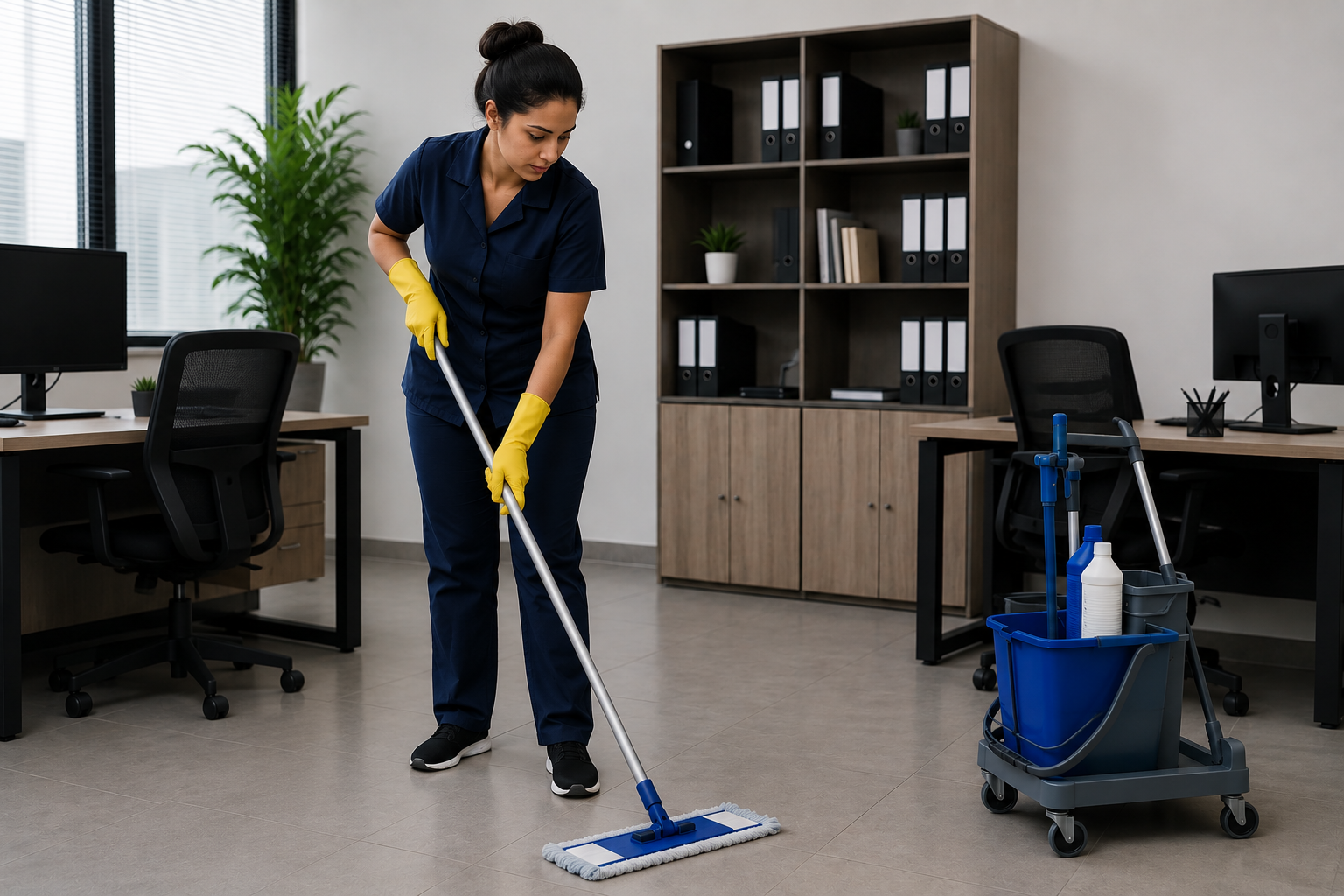
Office cleaning mistakes: the habits that harm hygiene and the maintenance of the corporate environment
Office cleaning mistakes are more common than many companies realise and can compromise not only the appearance of the environment, but also the health of staff, the maintenance of furniture, and the company’s professional image.
Small flaws in the sanitisation routine end up causing a build-up of dirt, surface wear and tear, and even an increase in maintenance costs.
Therefore, identifying the main office cleaning mistakes is essential to create a more organised, safe, and efficient corporate environment.
In addition to visual cleanliness, offices need constant care to prevent the proliferation of bacteria, dust, and residue in high-traffic areas.
In this content, you will understand the main mistakes made in corporate cleaning and how to avoid them in a practical way.
Using unsuitable products is one of the biggest office cleaning mistakes
Among the main office cleaning mistakes, the incorrect use of products is among the most frequent.
Many companies use generic products on all surfaces without considering the specific needs of each material.
Wooden desks, computer screens, glass, and floors have different characteristics and require specific care.
Harsh products can cause stains, wear and tear, and even permanent damage to furniture and equipment.
The impact of the wrong product on the corporate environment
When unsuitable products are used constantly, the office can look worn down even with frequent cleaning.
In addition, chemical residues can leave strong, uncomfortable odours for staff.
Choosing appropriate products for each surface helps to increase the durability of materials and significantly improves cleaning efficiency.
Ignoring high-touch areas
Another major office cleaning mistake is focusing only on visible areas and forgetting surfaces that are constantly touched throughout the day.
Places that accumulate the most contamination
Door handles, light switches, phones, keyboards, mice, and lift buttons accumulate a large amount of bacteria and dirt due to continuous hand contact.
Even when the office looks visually clean, these surfaces can become critical points of contamination if they are not sanitised correctly.
The importance of regular disinfection
The cleaning of these areas must be frequent and done with suitable disinfection products.This care reduces the risk of disease transmission and contributes to a healthier environment.
Too much product during cleaning
Many people believe that using more product means cleaner results, but this is one of the office cleaning mistakes that most hinders the final result.
How excess product can harm surfaces
The exaggerated use of disinfectants, detergents, and multi-purpose cleaners can leave built-up residue on furniture, floors, and glass. This creates stains, a greasy appearance, and even premature wear of materials.
In addition, excess product increases waste and raises the operational costs of corporate cleaning.
Balance is key
Efficient cleaning depends more on the correct technique than on the amount of product used. Moderate and well-distributed applications usually offer better results.
Using dirty cloths and materials
Among office cleaning mistakes, reusing contaminated or poorly washed cloths is an extremely harmful practice.
The problem of cross-contamination
When the same cloth is used in different environments without proper sanitisation, dirt and microorganisms end up being spread instead of removed.
This is a problem that occurs more frequently in toilets, kitchenettes, and shared areas.
The importance of separating materials
Ideally, cleaning materials should be separated by environment and washed regularly.
Microfibre cloths, for example, are very helpful in corporate cleaning because they accumulate less residue and offer better absorption.
Not following an organised cleaning routine
Another major office cleaning mistake is carrying out cleaning only when the environment appears to be dirty.
The importance of frequency
Offices have a constant flow of people, which causes dust, residue, and bacteria to accumulate quickly. Without a structured routine, small amounts of dirt turn into bigger problems.
Planning improves results
Creating a cleaning schedule helps to keep the environment continuously organised, in addition to making it easier to control tasks and the products used.
Neglecting the cleaning of electronic equipment
Computers, printers, and phones also need attention. Ignoring these items is among the most frequent office cleaning mistakes.
Build-up of dust and dirt
Electronic equipment accumulates dust easily, which can impair its operation and reduce its lifespan.
Specific care
Cleaning must be done with suitable materials and specific products for electronic equipment, avoiding excess liquids and damage to components.
Lack of ventilation during cleaning
Few people notice, but keeping the environment closed during sanitisation is also one of the common office cleaning mistakes.
Why is ventilation important?
Air circulation helps with the correct drying of surfaces and prevents the build-up of strong odours caused by cleaning products.
In addition, ventilated environments provide greater comfort for staff after cleaning.
Conclusion
Office cleaning mistakes may seem small on a day-to-day basis, but they cause significant impacts on the preservation of the environment, the health of staff, and the company’s image.
The inappropriate use of products, lack of organisation, and negligence with critical areas are common flaws that compromise the efficiency of sanitisation.
By correcting these habits and adopting more structured practices, it is possible to create a cleaner, safer, and more pleasant corporate environment.
Investing in correct cleaning processes is not just an aesthetic issue, but also an important strategy to improve the routine and productivity within the office.